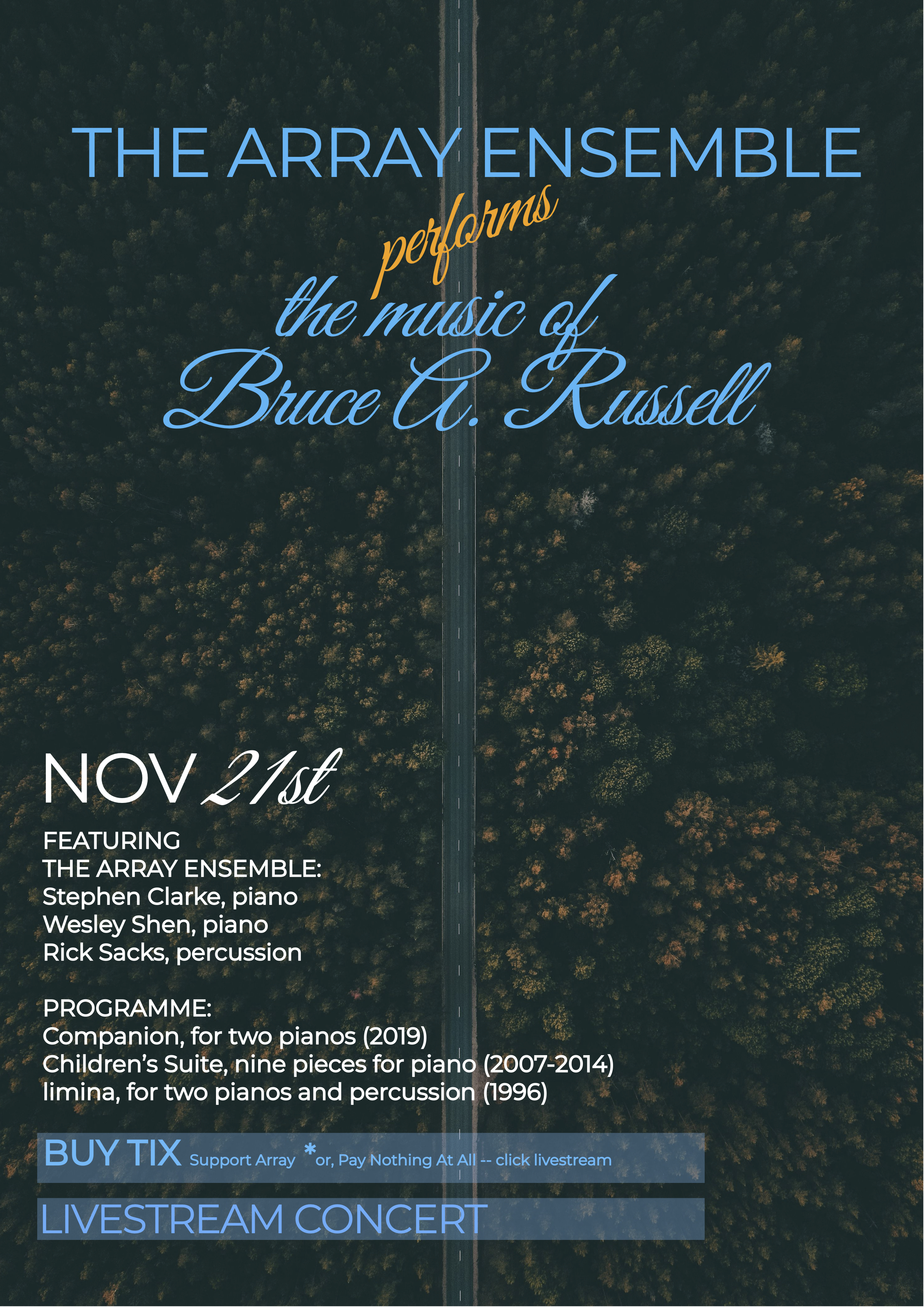
Here is the link for tonight’s first-ever concert of my music by The Array Ensemble. Viewing is free or by optional donation. You may be asked to create a free account in order to access the livestream. Please consider donating to Arraymusic as they are a historic and vital part of Toronto’s new music scene, and an important venue for providing access to underrepresented artist communities.
Programme and Notes
Companion, for two pianos (2019) 12′
Stephen Clarke, Wesley Shen; pianos
Children’s Suite, nine pieces for piano (2007-2014) 30′
Stephen Clarke, piano
aix, for two pianos (2004) 2′
Stephen Clarke, Wesley Shen; pianos
limina, for two pianos and percussion (1996) 5′
Stephen Clarke, Wesley Shen; pianos
Rick Sacks, percussion
—
Companion was composed through late 2018 and early 2019, while the first pencil sketches date to 2011. It is dedicated to my two youngest children. All of the material derives from seven-note rows: orderings of the pitches of the diatonic scale. The harmony resembles traditional tonality heard through a pandiatonic filter. There are four sections, divided by key signature: F major, A-flat major, B major and D major.
Each section is constructed from one or two unique, quasi-symmetrical rows that proceed most often by the interval of a fourth or fifth. Each row is layered against itself in a homorhythmic canon of up to six voices, often accompanied by high and low pedals tones that present an additional canon in augmentation. Almost every chord in Companion is the result of a basic serial process, one exception being the transition between the third and fourth sections, which features chords built from nested fifths. Ultimately, such chords result from the canons as well.
The final chord is arrived at through symmetrical voice leading from the penultimate chord and is also the initial row spelled vertically from bottom to top. Form at the local and vertical levels is highly rationalized, while global and horizontal form—rhythmic structure and phrasing—is loosely associative.
—
Children’s Suite (2007-2014) is a cycle of 3 three-movement pieces for piano which I composed for my children in the respective years of their births. All nine movements are written in diatonic C major/A minor. The cycle opens and closes with fast movements; otherwise, the music is in a slow to moderate tempo. All the pieces employ steady rhythmic motion, sometimes in triple or quadruple metre and sometimes in patterns of five, seven or nine beats. While there is a limited amount of complexity and abstraction in the tonal and rhythmic details, forms and structures are for the most part simple and pop-song like.
To varying degrees in each piece, I take inspiration from Bach’s Prelude in C Major, in the idea of a repeating pattern with changing harmonies. Some other ideas recur from one piece to another as well, such as a texture of broken chords which overlap in multi-voice canons (“A New Day,” “Fourths + Fifths,” “Lullaby”); a texture of bassline and suspended chords (“Oh Seven,” the latter sections of “Young Afro Future”); a harmonic structure of six diatonic modes in sequence (“Fourths + Fifths,” “Golden”) and the use of patterns from my kalimba music (the middle section of “Queen Peace,” “Golden,” the second section of “Son’s Light”).
The texture is often developed from a single line into homophony, with “Moon” being the clearest example. Here, a melodic fragment is harmonized with chord clusters and a descending bassline. The interval of the perfect fifth figures heavily throughout the suite, both melodically and harmonically; especially in “Oh Seven.” The opening section of “Son’s Light” has a traditional circle-of-fifths harmonic structure and includes the most triadic music I’ve composed since my early days writing pop songs.
“Queen Peace” is a simple waltz based on 4 four-note chords in A minor, with the bassline D, G, A, C. The melody flows out of the chords. While most of the suite was composed using a systematic approach, this movement grew more spontaneously from a pop sensibility.
The titles and ordering are as follows:
Remi (2007)
I. Oh Seven
II. Queen Peace
III. A New Day
Kenza (2012)
I. Fourths + Fifths
II. Moon
III. Golden
Tijani (2014)
I. Son’s Light
II. Lullaby
III. Young Afro Future
—
aix (“waters”), for two pianos, is a short study in rising and falling patterns, with alternating chordal and canonic textures. The primary melodic shape, an ascending seventh followed by a descending second, is heard in several of my piano pieces of the early to mid 2000s, which I later grouped together as a cycle under the title “Kindred Pieces.” The piece is written in diatonic A-flat major, with a harmonic progression on the scale degrees 4-3-2-1-5-6.
—
limina (1996), was composed as an exploratory diversion between larger projects. The title, “thresholds,” is meant to suggest points of transition or spaces between categories.
There are two sections; the longer and more eventful first is in duple metre and features a pop-like, four-chord progression in A major. The second is in triple metre and A-flat major, with an outro-like quality. The transition between sections introduces more complex harmonies and a percussion break.
All of the music is built around the initial melodic pattern, a loop that descends in fifths and ascends back to its starting point in fourths (a pattern also heard in “Fourth + Fifths”). This line is in fact the opening chord unfolded horizontally, and it becomes the rhythmic motor, layered against itself in canon. The final chord is the same as the opening one, though transposed down a semitone.
 EL MAHBOOB