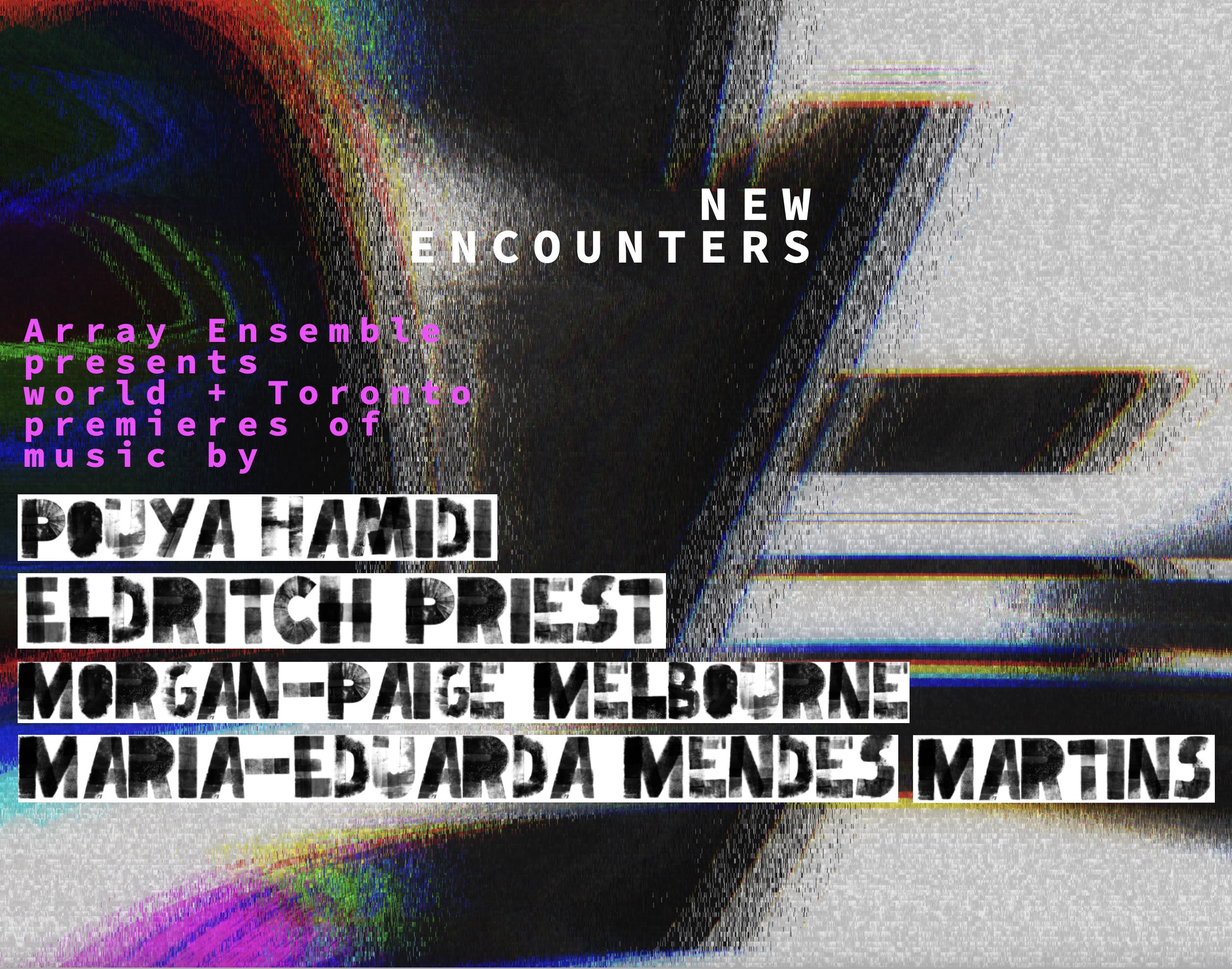
On Saturday, February 15, 2025, Arraymusic presents the second in a concert series I’ve titled New Encounters. In-person and livestream tickets available here. I curated this program, and it’s wonderful to assist in bringing these composers to a new audience.
Curator’s Note: The idea of the New Encounters concert, in contrast to its older cousin Four New Works, is that the pieces on the program are previously unheard by Arraymusic audiences if not all world premieres. This year, we’re fortunate that all four works will indeed be premieres, two of them arrangements by Pouya Hamidi and Morgan-Paige Melbourne of their existing music, and two freshly minted compositions by Maria-Eduarda Mendes Martins and Eldritch Priest. These creators are from very different sound worlds, and I’m excited for those to align in one evening with the Array Ensemble.
In August 2024, I recorded an interview with composer and educator Reid Contreras Woelfle for New Music Edmonton‘s The No Normal podcast. Grateful for the chance to expand on where I’m at, four years into this chapter, the rebirth. Available on SoundCloud (see below) and as an Apple podcast.
I’m pleased to announce the completion of a new work for string quartet, ex aliis matres, an autobiographical dedication to my mothers, a thematic embodiment of my origin story and a spiritual sequel to my first quartet, Madra. And I’m very much looking forward to the work’s premiere performance by the musicians who commissioned it, the Isabel String Quartet, in Kingston, Ontario (my birthplace) on February 24, 2025. The concert takes place in the beautiful Isabel Bader Centre for the Performing Arts at Queen’s University. I will be in attendance at the event.
Loss, the multimedia performance in which I acted as composer, music director and pianist/keyboardist in Toronto in June 2023, will return from January 9-11, 2025 at the Apollo Theater, Harlem, New York City, presented by the Apollo in partnership with the Under the Radar Festival. It’s an intimate, multigenerational family story about grief and healing, written by Ian Kamau and his father Roger McTair (1943-2024), and shared live on stage with music, video, sound and lighting design. Created by and for people of African/Caribbean descent, it’s one of the most personally resonant projects I’ve been connected with so far. I’m excited to reunite with Ian and the creative team including my fellow musicians, and to have my performance debut in the US at this historic location and venue. Tickets: https://www.apollotheater.org/event/losshttps://utrfest.org/program/loss
On Thursday, November 14th, I will be part of Artists in Conversation, discussing my piano compositions in person with junctQín keyboard collective‘s Stephanie Chua and Piano Lunaire‘s Adam Sherkin, and listening to them perform solo selections of mine that they are also playing in concerts during November. Questions and input from those in attendance are welcome. Details are below.
Date & Time: Thursday, November 14th, 7:30 pm (doors 7:00 pm) Location: Arraymusic, 155 Walnut Ave, 2nd floor, Toronto Admission: Free Duration: 1 hour Register your attendance in advance: info@pianolunaire.org
Go to my Events page to see the concerts related to this event.
On Sunday, November 10, 2024, Piano Lunaire will give the world concert premiere of For Celine (1995, dedicated to my niece). “Fourths + Fifths” (2012, from Children’s Suite) will also be performed. These two short pieces are part of Composers in Play XII: Still Reeling, an expansive program that highlights world premieres by Charlie Piper, composer and pianist Christopher Mayo, and composer, pianist and Piano Lunaire co-founder Adam Sherkin, as well as music by Allison Cameron, David Sawer and Sean Shepherd. The concert will take place at 3 pm at Arts & Letters Club, Toronto. Doors open at 2:30 pm.
On Saturday, November 23, 2024, the same program will be performed, with songs by Emily Hall sung by Nathaniel Sullivan in place of the Cameron work. This concert will take place at 8pm at the Tenri Cultural Institute, New York City.
I performed For Celine several times in the late 90s in informal settings, always from memory with a variable duration and improvised details. I’m excited to have it played for the first time in its notated form by an expert performer in fine settings. This will also be the first time “Fourths + Fifths” has been performed as a standalone work, and its second appearance on a program since Stephen Clarke premiered the complete Children’s Suite at Arraymusic in 2020.
I’m grateful for the opportunity to have my work presented by Adam and Christopher, two wonderfully accomplished artists.
On November 16th, 2024, my second portrait concert “Perhaps Bells” will take place at Arraymusic, with much anticipated performances by the adventurous and multi-talented junctQín keyboard collective. This is a special program I’ve been hoping to hear since the start of my Array residency. It’s all piano solos and duos, all world premieres of work composed in the 90s and 00s when there were few audiences or concerts if any, and includes a new arrangement of Madra (originally for variable instrumentation). These pieces relate directly to my recent ones written for Array and other ensembles. They were created under the influence of American and Canadian minimalists, popular music in general, and a more expansive list that includes Wally Badarou, Harold Budd, John Cage, Emahoy Tsegué-Maryam Guèbrou, Henryk Górecki, Kraftwerk, Arvo Pärt, Ryuichi Sakamoto, Erik Satie, Ann Southam, Linda Catlin Smith, and James Tenney.
On the same weekend, Freesound will present their season opening program in the Array Space (“Music for Piano Quartet II,” November 15th and 17th), making for an exciting mini-fest of contemporary concert music.
Stay tuned for another piano announcement (November is my piano month) and more.
On Sunday, June 23, 2024, a concert performance of my latest composition ex tempore (ik’stempəri) will be broadcast across Canada on CBC Radio’s “In Concert with Paolo Pietropaolo,” along with two other recorded performances from Arraymusic’s “New Encounters” concert on February 1st. Hanna Benn‘s Introitus and Kathryn Patricia Cobbler‘s Echoes will also be included in the broadcast. This will be a first for me both as a composer and curator. “In Concert” runs from 11:05am-3:00pm in five of Canada’s time zones (11:35am-3:30pm NT) and can be heard on terrestrial radio (94.1 FM in Toronto), streaming live at cbc.ca/listen or on the CBC Listen app. Select a city in the desired time zone on the app or website. The best time to tune in prior to the Arraymusic portion is 2:15pm.
I’m very pleased to share the studio recording (see below) and performance video of Sequences (2000 rev. 2024), featuring the University of Delaware Percussion Ensemble directed by Dr. Gene Koshinski, who gave the concert premiere of the piece in April 2024. The recording and video shoot were done in the weeks following the premiere. My thanks to the UD team for showing such care towards my work.
I composed Sequences at the start of a 20-year hiatus from the arts world, when I was composing in private and before any of my notated music had been played. I’d always hoped it would one day be performed, and it’s wonderful that it can have its own rebirth and reach listeners.
The title refers to sequences both in the sense of a musical phrase that repeats with a variation in pitch each time (in this case, with a variation in rhythm as well), and in the sense of arrangements programmed electronically using a sequencer.
The piece is a study in diatonic rhythms (the different phases of a 7-stroke pattern in a 12-beat cycle) which are paired with harmonically diatonic melodic canons. With each change of chord root, the overall pattern changes once or more. Four chords are used exclusively: D dominant, C major, G major and A minor, i.e., V – IV – I – ii in the key of G. There is a separate chordal flow and cadence on E minor in the bridge section.
Parameters vary within a narrow range: harmony, rhythmic phase, register that expands or contracts symmetrically from pattern to pattern, and interval quality, i.e., one pattern may feature predominantly small intervals and another, widely spaced ones. As the piece progresses, new sets of patterns emerge on the same four chords. Harmonic rhythm is slowed through increased repetition and variation.
Sequences shares some material in common with my string quartet Madra, as these compositions emerged during the same period (along with Kalimba Canon). My primary interest during this period was fusing a pop sensibility with minimalism derived from West African traditional structures.
The piece is not unlike a pop song in terms of its structure, duration, and harmonic character; however, a tension exists between this aspect and the statistical regularity of the material from beginning to end. The marimba parts require virtuoso players, while the “beat” is a relatively straightforward alternation of kick and cross stick with constantly varying accents in 3/2 metre, in response to the marimba music. The beat should support but not overpower the marimbas.
The piece initially included a TR-808 style electronic kick drum tuned to a single pitch, and in 2020, I expanded this part into a bassline for a tunable kick sound/bass synth. This can be played on a keyboard or pads, with the range of pitches being G0 to E1. The bassline exactly doubles the rhythm of the unpitched kick; the two lines should blend without either sound dominating the other.
Depending on tech setup, the piece can be performed as either a trio or quartet.
In 2024, I extended the piece with additional repeats, added a few subtle transitions in the beat/bassline, and created a new ending.
Recorded May 2024, University of Delaware, Newark, DE Shared with permission
Ensemble: Haolin Li and Joe Tremper, marimbas Gene Koshinski, bass synth and drum kit
Audio (mixing and editing): Gene Koshinski
Video and Lighting: Ben Hausman
Music and composer’s notes copyright Bruce A. Russell 2024
My composition Sequences (2000) will receive its belated world premiere this Saturday, April 20th, 2024 in a concert that runs from 3-4 pm EST. It will be livestreamed for free.
I’ve been waiting 24 years to hear this piece live! It’s for two marimbas and a light drum beat doubled with a synth bassline. It was revised this year for the University of Delaware Percussion Ensemble led by Dr. Gene Koshinski.
The music is from my Madra period, and is similarly small-scale minimalism, with all of its melodic and rhythmic patterns derived from the West African standard bell pattern and the harmony straight out of four-chord pop. It’s highly structured and finely detailed, and can be enjoyed simply with the body: groove music. It’s where I was stylistically just before I decided to put my aspirations as a working musician on pause (for twenty years…)
I don’t know the running order, so if you have an hour in your Saturday and would like to dedicate it to livestreamed percussion pieces… this is for you!


 EL MAHBOOB