Category: Percussion

  • Sequences — New Recording and Video

    I’m very pleased to share the studio recording (see below) and performance video of Sequences (2000 rev. 2024), featuring the University of Delaware Percussion Ensemble directed by Dr. Gene Koshinski, who gave the concert premiere of the piece in April 2024. The recording and video shoot were done in the weeks following the premiere. My thanks to the UD team for showing such care towards my work.

    I composed Sequences at the start of a 20-year hiatus from the arts world, when I was composing in private and before any of my notated music had been played. I’d always hoped it would one day be performed, and it’s wonderful that it can have its own rebirth and reach listeners.

    The title refers to sequences both in the sense of a musical phrase that repeats with a variation in pitch each time (in this case, with a variation in rhythm as well), and in the sense of arrangements programmed electronically using a sequencer.

    The piece is a study in diatonic rhythms (the different phases of a 7-stroke pattern in a 12-beat cycle) which are paired with harmonically diatonic melodic canons. With each change of chord root, the overall pattern changes once or more. Four chords are used exclusively: D dominant, C major, G major and A minor, i.e., V – IV – I – ii in the key of G. There is a separate chordal flow and cadence on E minor in the bridge section.

    Parameters vary within a narrow range: harmony, rhythmic phase, register that expands or contracts symmetrically from pattern to pattern, and interval quality, i.e., one pattern may feature predominantly small intervals and another, widely spaced ones. As the piece progresses, new sets of patterns emerge on the same four chords. Harmonic rhythm is slowed through increased repetition and variation.

    Sequences shares some material in common with my string quartet Madra, as these compositions emerged during the same period (along with Kalimba Canon). My primary interest during this period was fusing a pop sensibility with minimalism derived from West African traditional structures.

    The piece is not unlike a pop song in terms of its structure, duration, and harmonic character; however, a tension exists between this aspect and the statistical regularity of the material from beginning to end. The marimba parts require virtuoso players, while the “beat” is a relatively straightforward alternation of kick and cross stick with constantly varying accents in 3/2 metre, in response to the marimba music. The beat should support but not overpower the marimbas.

    The piece initially included a TR-808 style electronic kick drum tuned to a single pitch, and in 2020, I expanded this part into a bassline for a tunable kick sound/bass synth. This can be played on a keyboard or pads, with the range of pitches being G0 to E1. The bassline exactly doubles the rhythm of the unpitched kick; the two lines should blend without either sound dominating the other.

    Depending on tech setup, the piece can be performed as either a trio or quartet.

    In 2024, I extended the piece with additional repeats, added a few subtle transitions in the beat/bassline, and created a new ending.

    Recorded May 2024, University of Delaware, Newark, DE
    Shared with permission

    Ensemble:
    Haolin Li and Joe Tremper, marimbas
    Gene Koshinski, bass synth and drum kit

    Audio (mixing and editing):
    Gene Koshinski

    Video and Lighting:
    Ben Hausman

    Music and composer’s notes copyright Bruce A. Russell 2024

  • World Premiere: Sequences

    My composition Sequences (2000) will receive its belated world premiere this Saturday, April 20th, 2024 in a concert that runs from 3-4 pm EST. It will be livestreamed for free.

    I’ve been waiting 24 years to hear this piece live! It’s for two marimbas and a light drum beat doubled with a synth bassline. It was revised this year for the University of Delaware Percussion Ensemble led by Dr. Gene Koshinski.

    The music is from my Madra period, and is similarly small-scale minimalism, with all of its melodic and rhythmic patterns derived from the West African standard bell pattern and the harmony straight out of four-chord pop. It’s highly structured and finely detailed, and can be enjoyed simply with the body: groove music. It’s where I was stylistically just before I decided to put my aspirations as a working musician on pause (for twenty years…)

    I don’t know the running order, so if you have an hour in your Saturday and would like to dedicate it to livestreamed percussion pieces… this is for you!

  • ex tempore World Premiere

    On Thursday, February 1, 2024, as part of New Encounters, the Array Ensemble will give the premiere performance of my new work ex tempore (ik’stempəri – out of the moment / out of time / at the time / from time), for flute, clarinet, percussion, violin, and cello. The piece is dedicated to the memory of composer Ann Southam, a pioneer for women in Canadian composition.

    Recently, I found an old cassette which contained a fragment of an interview I did with Southam at CIUT in 1999. I was reminded that I had asked her if she had advice for young composers, to which she responded, “Don’t get pushed around by influences, just listen to your own voice as much as you can.” That seemed a good starting point for a piece, flipping the intention to explore the nature of influence as another kind of listening.

    The title is intended to encompass several possible interpretations; for example, something improvised (in terms of compositional decisions rather than performance), or an immediate judgement without full consideration (as a legal term and reflecting our current times). The temporal theme applies to Southam’s minimalist pieces, in which material is spun out gradually over an extended duration, allowing it to be explored in detail or meditated upon. While I don’t quote Southam’s music, her technique of layering patterns to “spontaneously produce little tunes” has always appealed to me.

    I juxtapose concise structures from pop, R&B, rock, and reggae absorbed in my formative years with the influence of minimalism present since my early work. Southam was inspired by Steve Reich, whose music I studied informally while also briefly studying Ghanaian drumming performance. I came to understand that the interlocking parts and West African timekeeping patterns which became a minimalist signature have always been part of African diasporic musical traditions, suggesting broader connections and possibilities in terms of style.

    ex tempore is a companion to ex harmonia (2023), which was dedicated in memory of James Tenney, another important figure in my development. While both are chamber quintets written while I’m the Composer-in-Residence at Arraymusic, there are differences between the two pieces in terms of form and instrumentation. Each piece finds a unique balance of formalism and intuitive expression. In contrast to the earlier, longer piece, this one is focused less on systematic development of the material than casual variations on diatonic chord progressions, groove, and a sense of play. There are four key sections: D major, F major, B major and A-flat major (which includes a short passage in E-flat major/C natural minor). All the chord progressions in the piece are based on a cycle of fifths, with which I create melodic sequences and canons. The outer sections are busy, the inner ones, calmer. The tempo remains steady, while changing note values create a sense of the music being fast or slow moving.

    My other projects of 2023, Loss (a multi-media live show written by Ian Kamau and Roger McTair and presented at Luminato Festival Toronto) and cane (for Artemis Musicians’ Society, premiere TBA), were neighbouring points along the creative curve.

    New Encounters marks my first event as a curator. An interesting part of the process was gathering the other composers through their works and then only afterwards deciding what to include of my own, which was eventually a newly composed piece. I didn’t necessarily try to relate my music to the other composers, but I did get a sense of how special and unique all our voices are as Black creators. Greater than the sum of our influences, perhaps, and yet those influences are always there, manifest, or not.

    I’m honoured to program my music in the presence of the celebrated work of Anthony R. Green, Hanna Benn, and Kathryn Patricia Cobbler. Each of their contributions to the program are so compelling in their own ways, reflecting a lot of loving labour and lived experience. I’m also thrilled to once again have the top flight musicians of the Array Ensemble performing my work.

  • Livestream and Programme for “The Music of Bruce A. Russell”

    Here is the link for tonight’s first-ever concert of my music by The Array Ensemble. Viewing is free or by optional donation. You may be asked to create a free account in order to access the livestream. Please consider donating to Arraymusic as they are a historic and vital part of Toronto’s new music scene, and an important venue for providing access to underrepresented artist communities.

    Programme and Notes

    Companion, for two pianos (2019) 12′
    Stephen Clarke, Wesley Shen; pianos


    Children’s Suite, nine pieces for piano (2007-2014) 30′
    Stephen Clarke, piano


    aix, for two pianos (2004) 2′
    Stephen Clarke, Wesley Shen; pianos


    limina, for two pianos and percussion (1996) 5′
    Stephen Clarke, Wesley Shen; pianos
    Rick Sacks, percussion

    Companion was composed through late 2018 and early 2019, while the first pencil sketches date to 2011. It is dedicated to my two youngest children. All of the material derives from seven-note rows: orderings of the pitches of the diatonic scale. The harmony resembles traditional tonality heard through a pandiatonic filter. There are four sections, divided by key signature: F major, A-flat major, B major and D major.

    Each section is constructed from one or two unique, quasi-symmetrical rows that proceed most often by the interval of a fourth or fifth. Each row is layered against itself in a homorhythmic canon of up to six voices, often accompanied by high and low pedals tones that present an additional canon in augmentation. Almost every chord in Companion is the result of a basic serial process, one exception being the transition between the third and fourth sections, which features chords built from nested fifths. Ultimately, such chords result from the canons as well.

    The final chord is arrived at through symmetrical voice leading from the penultimate chord and is also the initial row spelled vertically from bottom to top. Form at the local and vertical levels is highly rationalized, while global and horizontal form—rhythmic structure and phrasing—is loosely associative.

    Children’s Suite (2007-2014) is a cycle of 3 three-movement pieces for piano which I composed for my children in the respective years of their births. All nine movements are written in diatonic C major/A minor. The cycle opens and closes with fast movements; otherwise, the music is in a slow to moderate tempo. All the pieces employ steady rhythmic motion, sometimes in triple or quadruple metre and sometimes in patterns of five, seven or nine beats. While there is a limited amount of complexity and abstraction in the tonal and rhythmic details, forms and structures are for the most part simple and pop-song like. 

    To varying degrees in each piece, I take inspiration from Bach’s Prelude in C Major, in the idea of a repeating pattern with changing harmonies. Some other ideas recur from one piece to another as well, such as a texture of broken chords which overlap in multi-voice canons (“A New Day,” “Fourths + Fifths,” “Lullaby”); a texture of bassline and suspended chords (“Oh Seven,” the latter sections of “Young Afro Future”); a harmonic structure of six diatonic modes in sequence (“Fourths + Fifths,” “Golden”) and the use of patterns from my kalimba music (the middle section of “Queen Peace,” “Golden,” the second section of “Son’s Light”). 

    The texture is often developed from a single line into homophony, with “Moon” being the clearest example. Here, a melodic fragment is harmonized with chord clusters and a descending bassline. The interval of the perfect fifth figures heavily throughout the suite, both melodically and harmonically; especially in “Oh Seven.” The opening section of “Son’s Light” has a traditional circle-of-fifths harmonic structure and includes the most triadic music I’ve composed since my early days writing pop songs.

    “Queen Peace” is a simple waltz based on 4 four-note chords in A minor, with the bassline D, G, A, C. The melody flows out of the chords. While most of the suite was composed using a systematic approach, this movement grew more spontaneously from a pop sensibility.

    The titles and ordering are as follows:

    Remi (2007)
    I. Oh Seven
    II. Queen Peace
    III. A New Day
    Kenza (2012)
    I. Fourths + Fifths
    II. Moon
    III. Golden
    Tijani (2014)
    I. Son’s Light
    II. Lullaby
    III. Young Afro Future

    aix (“waters”), for two pianos, is a short study in rising and falling patterns, with alternating chordal and canonic textures. The primary melodic shape, an ascending seventh followed by a descending second, is heard in several of my piano pieces of the early to mid 2000s, which I later grouped together as a cycle under the title “Kindred Pieces.” The piece is written in diatonic A-flat major, with a harmonic progression on the scale degrees 4-3-2-1-5-6.

    limina (1996), was composed as an exploratory diversion between larger projects. The title, “thresholds,” is meant to suggest points of transition or spaces between categories.

    There are two sections; the longer and more eventful first is in duple metre and features a pop-like, four-chord progression in A major. The second is in triple metre and A-flat major, with an outro-like quality. The transition between sections introduces more complex harmonies and a percussion break.

    All of the music is built around the initial melodic pattern, a loop that descends in fifths and ascends back to its starting point in fourths (a pattern also heard in “Fourth + Fifths”). This line is in fact the opening chord unfolded horizontally, and it becomes the rhythmic motor, layered against itself in canon. The final chord is the same as the opening one, though transposed down a semitone.
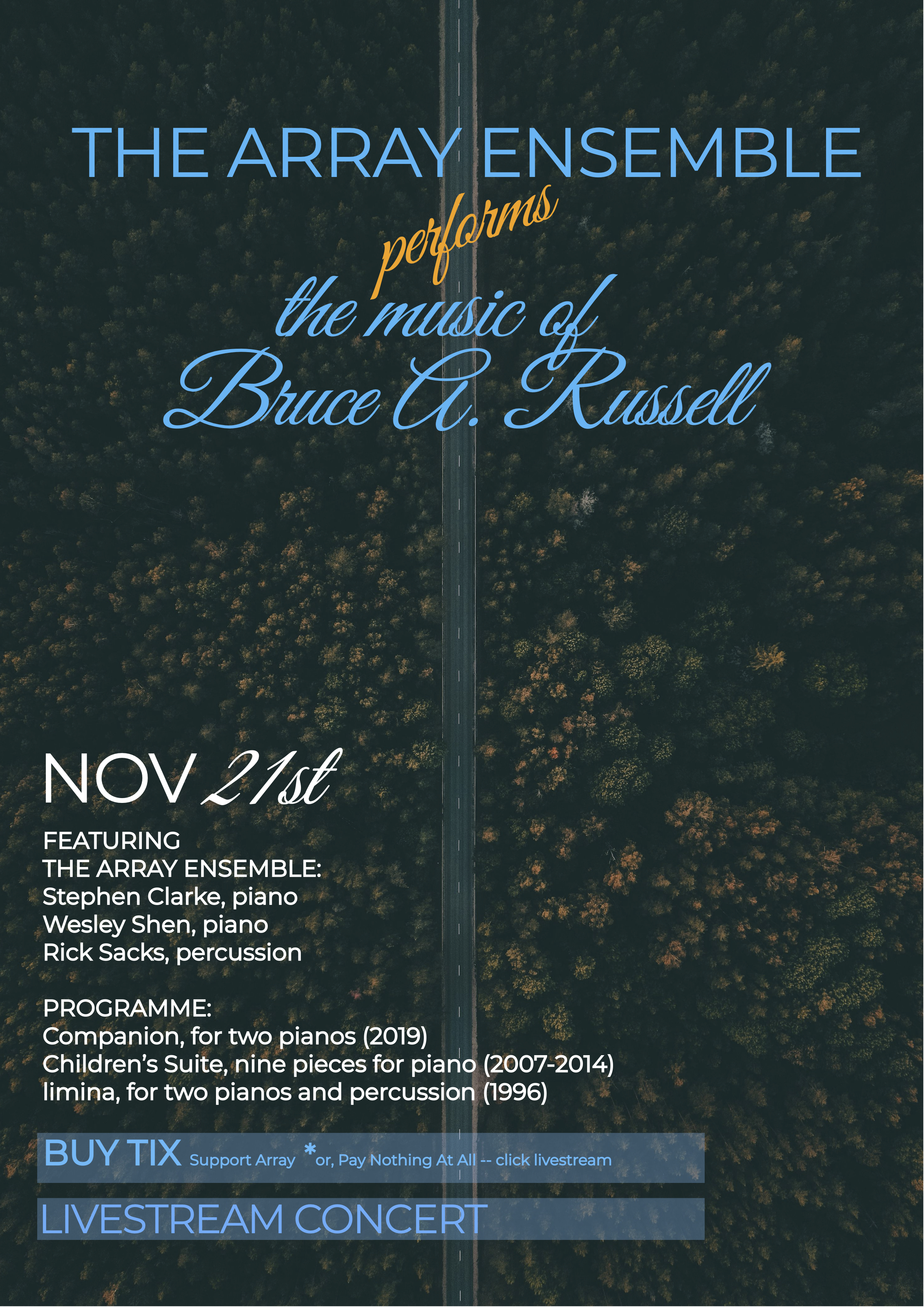
  • Arraymusic Presents “The Music of Bruce A. Russell”

    In two weeks, on Saturday, November 21st at 8 pm EST, the Array Ensemble will present the first ever live concert dedicated to my music, featuring all world premieres. It will be livestreamed from https://www.arraymusic.ca/brucerussell/ and tickets are by donation (or free). The performers are legends: Stephen Clarke and Wesley Shen on pianos, and Rick Sacks on percussion.

    Programme:

    Companion, for two pianos (2019)

    Children’s Suite, nine pieces for piano (2007-2014)

    aix, for two pianos (2004)

    limina, for two pianos and percussion (1996)

    My sincere gratitude to Artistic Director David Schotzko, the performers and the team at Arraymusic for committing to this. I’m donating my earnings from this event after expenses to these organizations, among others: Black Legal Action Centre (BLAC), Black Lives Matter – Canada, FoodShare Toronto, 1492 Land Back Lane – Legal Fund and to Arraymusic, who have been giving artists across communities a space to create and perform for many years.

  • New Kalimba Canon Video

    A little over a week after they gave the live world premiere of Kalimba Canon (1999), Prism Percussion have released a one-take performance video of the piece, recorded earlier in the fall. The performance and acoustics are stunning; the imagery speaks for itself in the moment we’re in.

  • Kalimba Canon Live

    On Friday, October 30th, 2020, Prism Percussion will give the live concert premiere of my Kalimba Canon (1999), in a concert hosted by the Golden Gate Symphony Orchestra and Chorus. The program of percussion duets also includes music by Adrea Venet, Eric Cha-Beach, Alexandra Gardner and Molly Joyce. It can be streamed via this link at Facebook Live. The concert runs from 7:30-8:30 EDT.

    Prism Percussion “explores the expressive colors of percussive sounds utilizing non-standard instruments and seeks to champion works by Black, Indigenous, People of Color, Female and Queer composers.”

  • Kalimba Canon premiere

    On July 17, 2020, Second Note Duo (Gabriel Costache and Will Richards) gave the world premiere of Kalimba Canon (1999). It was the final composition presented in their socially distanced, video recital A Day in the Life. Second Note contacted me a little over a month prior to the release date, and things came together quickly including sourcing instruments to play the piece. I am thrilled with the result. Funds were donated to the Black Legal Action Centre.

    Two alto kalimbas play identical melodic loops, with the second kalimba echoing several beats behind the first, to create a composite musical line. Minimalism in miniature. Will (kalimba 1) recorded his part at his home in Illinois, while Gabriel (kalimba 2) recorded at his home in Colorado. The mirrored outdoor setting for this sequence in the video—sunsets near water—is a perfect one for the piece.

    Composed January 1999
    Recorded and premiered July 2020

    Photo: original instrument and score notebook, July 2020

    Music and composer’s notes copyright Bruce A. Russell 2020