A little over a week after they gave the live world premiere of Kalimba Canon (1999), Prism Percussion have released a one-take performance video of the piece, recorded earlier in the fall. The performance and acoustics are stunning; the imagery speaks for itself in the moment we’re in.
Category: Compositions
-
Kalimba Canon Live
On Friday, October 30th, 2020, Prism Percussion will give the live concert premiere of my Kalimba Canon (1999), in a concert hosted by the Golden Gate Symphony Orchestra and Chorus. The program of percussion duets also includes music by Adrea Venet, Eric Cha-Beach, Alexandra Gardner and Molly Joyce. It can be streamed via this link at Facebook Live. The concert runs from 7:30-8:30 EDT.
Prism Percussion “explores the expressive colors of percussive sounds utilizing non-standard instruments and seeks to champion works by Black, Indigenous, People of Color, Female and Queer composers.”
-
90/30: Eccentricities
Eccentricities is a six-song, self-released cassette EP which emerged in the fall of 1990. I recall having 100 copies made and being satisfied with that level of dispersion; it was all I could afford in any case. In honour of the 30th anniversary, I present two of the songs here (with a third linked below).
My recordings during this period were all effectively demos. Made with no budget, engineers, producers, retakes, final mixdowns, editing, mastering, label releases or promotion. They were an in the moment document, like the solo piano recordings I turned to focus on in later decades, created with a minimum of tools and preparation and on the raw side. There are many songs and pieces I’ve returned to for revision or reimagining, but the version 1.0s are always done quickly, very rarely seeing a live performance.
Track 1, side B. In its awkward, often corny way, “The Gardener” was about envisioning a sustainable, equitable and peaceful future. Musically, it looked back on the two decades which preceded it terms of tempo, rhythm and melodic style; and even further back in the century with the use of stacked-fifth chords as the main harmonic fabric. All the keyboard parts were performed live. The presence of the TR-808 marked the first time I incorporated a preprogrammed element into my music. I often wish I had seen fit to capture it on its own as a stem as it was so fun to make, and like the song itself, it expressed a unique side of my musical thought at a particular time.
Written and recorded July 1990
half-inch 8-track, unmastered mixdown to DAT
Roland S-50, Roland TR-808, Yahama DX-27, Fender bass, voiceTrack 3, side B. “One Foot Firmly Planted” is the closing song of the EP, and like “The Gardener” which opens the side, it employs chords of stacked fifths in the organ as the harmonic material, sometimes doubled here by the voices. The intro is clearly modelled upon Steve Reich’s “Tehillim.” It’s a piece which did not “emerge from the ground” as I boast in the liner notes but neverthless formed spontaneously, layer by layer from a bare bones beat of conga, clapping and floor tom; coloured with organ and hailed by some strange, quasi-philosophical, quasi-choral voices. In an unconscious nod to the period of study of electroacoustic composition which I had just concluded, I randomly spliced and recombined the last few seconds of the multitrack tape, where the song disintegrates.
Written and recorded July 1990
half-inch 8-track, unmastered mixdown to DAT
percussion, Korg CX-3, voice
(Also from Eccentricities, Track 3, side A, “Quarter-Tone Study.”)Music and composer’s notes copyright Bruce A. Russell 2020
-
Emergence: Linea Nigra in Concert
My octet for strings Linea Nigra (2015) will receive its world premiere this Saturday, October 3rd at 7:30 pm MDT, in the release of a prerecorded performance by the San Juan Symphony, conducted by music director Thomas Heuser. It will feature as part of a program entitled “Black Voices and A Ballet for Martha,” which opens the orchestra’s virtual 35th Season. The program also includes Jessie Montgomery‘s Voodoo Dolls (2012) for string quintet, and the suite from Aaron Copland’s Appalachian Spring (2012) in the original scoring for 13 instruments. The concert requires the purchase of digital access in order to view it.
I recorded a conversation with Thomas on September 30th which is viewable for a limited time here. I discuss the origins of Linea Nigra, the compositional techniques it employs, and how it relates to my own cultural story.
The piece will in fact receive a double premiere: a second prerecorded performance, by the Idaho Falls Symphony, will be released in a virtual concert also conducted by Thomas Heuser on Saturday, October 10th at 7:30 pm MDT. This program also includes Jessie Montgomery’s Starburst for string orchestra, Hanna Benn‘s Where Springs Not Fail, and the suite from Copland’s Appalachian Spring. Tickets are available here.
These performances will represent my debut on a symphony orchestra program. While my piece is for a chamber ensemble, the need for a socially distanced performance environment for the concert provided the opportunity for it to be included. The offer came out of the blue less than three months ago, and I am thrilled and humbled.
While I was more or less retired from an active life in music, this blog, my SoundCloud page and the writing I’ve done for I Care If You Listen have kept me just visible enough, it seems. Since June, I’ve been getting a lot of requests from musicians and ensembles looking for a Black composer to actualize their commitments to social equity in their programming. It’s sobering as to when and why this has come about, but I’m taking it as a call to action.
I have donated my earnings thus far from these engagements to Black legal justice causes and the families of the victims of police shootings and SIU incidents in the US and Canada. In several cases, the musicians who purchased my music have made matching donations in their communities; in San Francisco, Louisville and Vancouver, to name a few. It means a lot to me that my music can be part of something more than just art for art’s sake, but whether or not this is all just performative (not referring to musical performance but politically correct virtue signalling) depends on real systemic change happening.
Is this my emergence as a composer, decades late? Time will tell. Watch this space.
-
Kalimba Canon premiere
On July 17, 2020, Second Note Duo (Gabriel Costache and Will Richards) gave the world premiere of Kalimba Canon (1999). It was the final composition presented in their socially distanced, video recital A Day in the Life. Second Note contacted me a little over a month prior to the release date, and things came together quickly including sourcing instruments to play the piece. I am thrilled with the result. Funds were donated to the Black Legal Action Centre.
Two alto kalimbas play identical melodic loops, with the second kalimba echoing several beats behind the first, to create a composite musical line. Minimalism in miniature. Will (kalimba 1) recorded his part at his home in Illinois, while Gabriel (kalimba 2) recorded at his home in Colorado. The mirrored outdoor setting for this sequence in the video—sunsets near water—is a perfect one for the piece.
Composed January 1999
Recorded and premiered July 2020Photo: original instrument and score notebook, July 2020
Music and composer’s notes copyright Bruce A. Russell 2020
-
aix
aix (“waters”), for two pianos, is a short study in rising and falling patterns, with alternating chordal and canonic textures. The primary melodic shape, an ascending seventh followed by a descending second, is heard in several of my piano pieces of this period.
Composed and recorded 2004, Korg 01/WFD
Restored from playback on the original device, 2019Photo: breakwater, Marilyn Bell Park, Toronto
Music and composer’s notes copyright Bruce A. Russell 2019
-
1996+21: limina
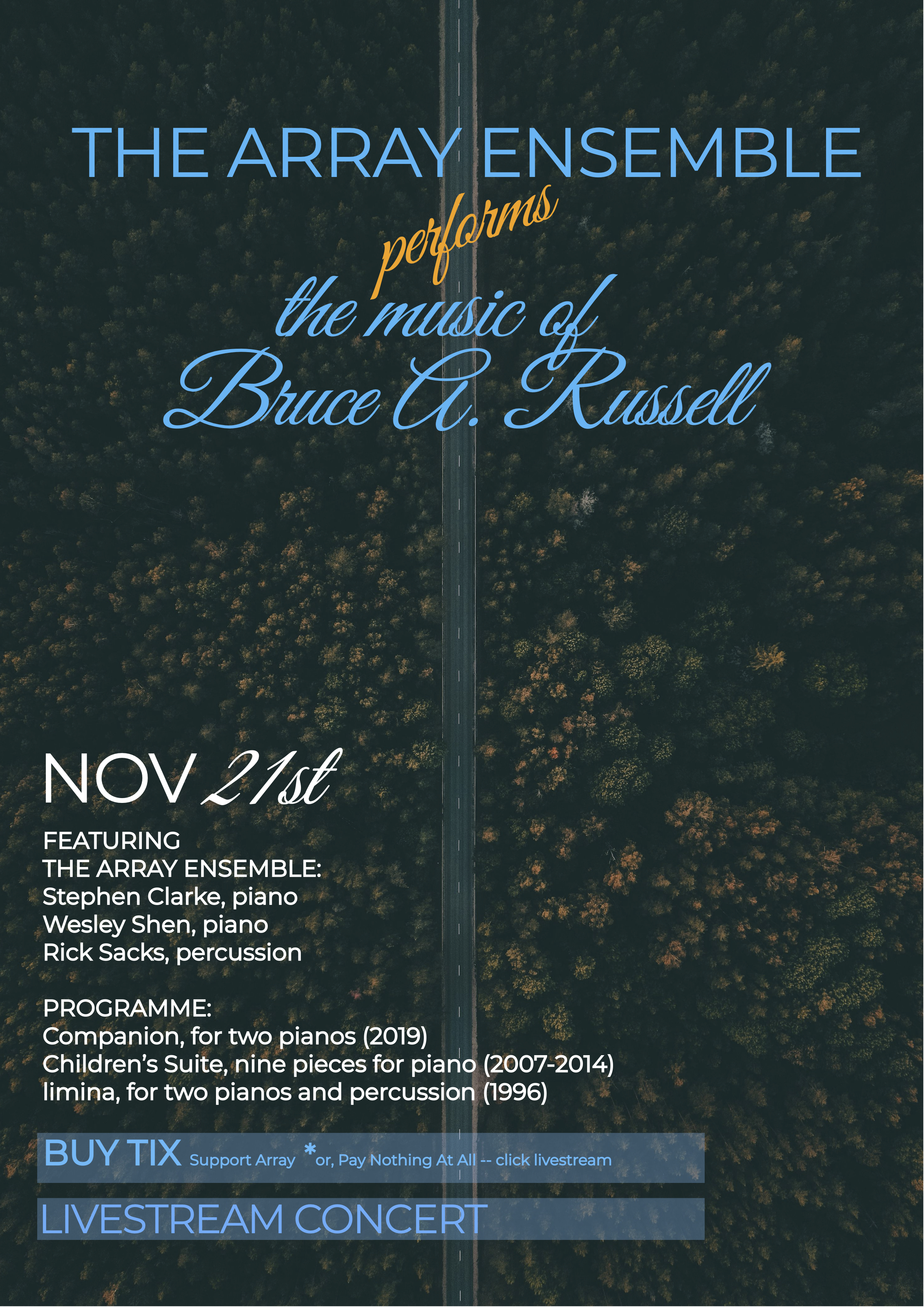
limina, for two pianos and percussion (1996), was composed as an exploratory diversion between larger projects. The title, “thresholds,” is meant to suggest points of transition or spaces between categories.
There are two sections; the longer and more eventful first is in duple metre and features a pop-like, four-chord progression in A major. The second is in triple metre and A-flat major, with an outro-like quality. The transition between sections introduces more complex harmonies and a percussion break.
All of the music is built around the initial melodic pattern, a loop that descends in fifths and ascends back to its starting point in fourths. This line is in fact the opening chord unfolded horizontally, and it becomes the rhythmic motor, layered against itself in canon. The final chord is the same as the opening one, though transposed down a semitone.
Composed and recorded August 1996, Korg 01/WFD
Remixed May 2017Photo: composer, 1997
Music and composer’s notes copyright Bruce A. Russell 2017
-
Linea Nigra, for string octet
Linea Nigra (2015) began as an orchestration of my piano piece Canon Chorale (2005). It is scored for string octet, in this case the same configuration as a double string quartet. Most of the structure and content of the earlier work are retained as a kind of continuo, to which newly devised material adds range and contrapuntal detail.
The general technique is a variation of first species counterpoint. A set of short melodies in each of the modes of C major are heard in two- to six-voice, note-on-note canons at the unison and octave, creating a sequence of block chords, or a chorale. The resulting harmonic progressions may have a cloud-like feel to them especially as melodic lengths and part density increase, and chord roots become ambiguous. Towards the end, faster melodic lines develop out of a recurring a triplet pattern.
The title of the piece reflects my own quest for my biological and cultural roots. Linea nigra (“black line”) thus references the vertical line that appears on a woman’s belly in some pregnancies, while it also suggests Black lineage and survival. It could also stand in the sense of a melodic line, printed or otherwise.
My great thanks go to Ashil Mistry, who suggested the instrumentation and generously edited the score, as well as directing the performance heard here.
Recorded July 3, 2016, London, UK
Scheme Ensemble
Ashil Mistry, conductorMusic and composer’s notes copyright Bruce A. Russell 2016
-
Superscription
“Sequence, symmetry & simplicity” — my composer’s motto, 1996. 15 years later, inspiration strikes and the same schemes still sparkle.